Ținutul Pădurenilor (the Land of the Forest People)
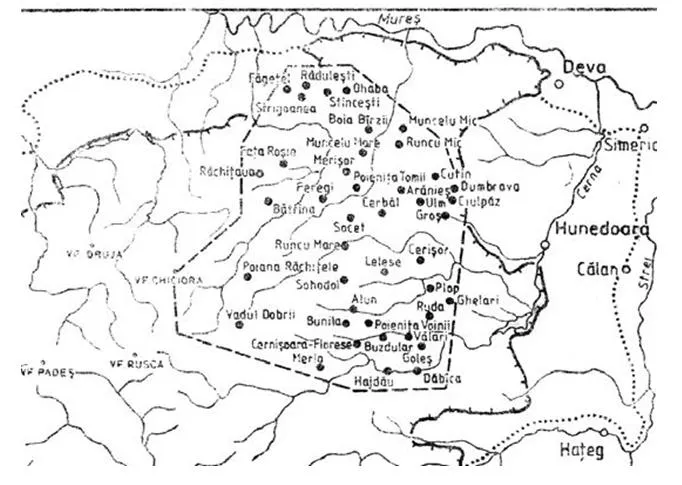
Location
Ținutul Pădurenilor lies in Hunedoara County, in the valley of the Cerna River. It is bounded to the north by the Mureș valley, to the south by Țara Hațegului and to the west by the Poiana Ruscă Mountains, and it is considered one of the richest ethnographic areas of Romania. Because of the terrain, made up mostly of wooded ridges, the main occupations of the "pădureni" (the forest people) are logging, woodworking and shepherding.
History
The history of Ținutul Pădurenilor goes back a long way, overlying an ancient Dacian heartland. At the beginning of the 2nd century AD, the eastern part of the Poiana Ruscă Mountains lay within the area of the main Dacian and Roman centres.
Very close by, in the Hațeg depression, stood the capital of the province of Dacia, Ulpia Traiana Sarmizegetusa. It is said that some of the Dacians who withdrew into the mountains took refuge in this area.
This geographical isolation of the pădureni settlements probably allowed them, for centuries on end, to preserve their present-day dialect and certain distinctive features of their dress, which some researchers say resemble that of the Dacians. The first written record of the settlements of this land dates from 1297, in a document in which the villages of Zlaști and Ruda are mentioned as subjects of the castellan of Hunedoara. Later, in the 14th and 15th centuries, we find mentions of all the settlements known today, as well as of others that probably disappeared over time.
Tourist attractions
- Românești Cave
- The Luncani Plateau
- Corvin Castle
- The wooden church in the village of Ruda, dating from 1653;
- The iron blast furnace in the village of Govăjdia, dating from 1806: notably, the support pillars of the Eiffel Tower in Paris were cast at this furnace;
- The mining and processing of iron ore is attested in documents and by archaeology from the 9th century; in the commune of Ghelari one can visit the "tall shaft furnace" at the place called Valea Caselor, a scale model of which is displayed at the British Museum in London;
- Along the valleys of the Retișoara and Nădrab streams there is a railway line, attested by documents in the town hall archives, which since 1902 has been called "the First Railway of Transylvania";
The village
The traditional house
Peasant homesteads were enclosed by wattle fences topped with straw and consisted of the house proper, the barn (which also included the stable, the pigsty and sometimes a shed sheltering the cart, the sleigh and other tools for field work), as well as a dugout that served as a cellar.
The house stood at the back of the yard, always facing the road, while the barn was near the road.
The traditional houses of Pădureni had two rooms, the living room and the pantry, with separate entrances from a porch placed at the corner in front of the pantry or along the façade. The dwellings catch the eye through their proportions, the roof being two or three times taller than the walls.
The local people, the pădureni
The people of Pădureni live in small villages set on ridges and hilltops. Thanks to the special geographical conditions, one of the most original folk cultures developed here. The inhabitants of Ținutul Pădurenilor simply call themselves "pădureni". They form an "ethnographic island" in which an archaic folk culture has been preserved, highly original and quite distinct from that of the neighbouring regions. The main features of this culture are: settlements placed on ridges, crops grown on terraced hillsides, the absence of pottery, the distinctive dress (especially that of the women) and the dialect.
The villages of the pădureni do not extend beyond the high plateau zone of the Poiana Ruscă Mountains.
The occupations of the pădureni
In the past, most of the inhabitants of the pădureni villages worked in the mines of Ghelari and Teliuc, in the works at Govăjdia and Hunedoara, in the talc mines of Lelese and Cerișor or in the marble quarry at Alun. Other occupations specific to the area were cattle raising, cultivating small plots on levelled terraces around the settlements, wood carving, weaving and embroidery, all within the limits of their own household needs. In recent times mining and forestry work have become the main occupations of the pădureni. As a curiosity, the craft of pottery is absent from this area.
The folk costume
The traditional dress of Ținutul Pădurenilor (especially the women's) is considered the most archaic and best preserved in the whole country and one of the oldest in Europe. The way the women of this land gird their waists is one of the most complicated and interesting, with meanings reaching back to the Neolithic, recalling traces of an ancient Dacian art of metalworking, as well as certain of their rites and cults, now vanished, and their beliefs, strongly tied to the rituals of sun worship. It is even said that the dress of the pădureni was very similar to that worn by the Dacians, and the women's hairstyle likewise.
The women's costume is tastefully decorated with geometric patterns framed in right-angled borders and developed mainly vertically. On her head the woman wears an embroidered veil of fine linen that hangs down her back almost to the ground. The headdress is a kerchief from under which two locks of hair emerge symmetrically in the shape of tusks, stiffened and stuck to the forehead with sugar dissolved in water. Around her neck she wears necklaces of coins or beads. The women wear oprege (in front and behind), two woollen pieces that wrap the lower part of the body, drawn tight like a wrap skirt, which gives the pădureni woman a slimmer look. The blouse is richly ornamented with wide panels along the sleeves and at the neckline, with heavy and striking stitching in harsh colours: red, black and blue. The blouse is decorated with traditional patterns on the shoulders, along the edge of the sleeves and on the chest. Around the waist she wears a beautifully woven belt adorned with beads, coins and rings. Over the belt she wears a chain. On her chest she wears sheepskin vests, again embroidered. Over all these she throws on her shoulder a short white woollen cloak with a hood. Her favourite footwear is the opincă, the peasant sandal.
The men's clothing is less complicated: a linen shirt, not very long, with wide sleeves, tied at the waist with a broad leather belt. The trousers are of white wool. A sheepskin vest over which they put on the "recalu". On their heads they wear a hat with a narrow, turned-up brim, on their feet opinci, and on their shoulder a cloak. The details of the adornment of the women's waists suggest traces of an ancient art of metalworking, as well as remnants of a mentality tied to certain rites and cults now vanished, among which the "solar" ones were predominant.
On their feet, women and men wear opinci with very high pointed toes. The men wear tight woollen trousers, a short woollen jacket and a hat with a turned-up brim.
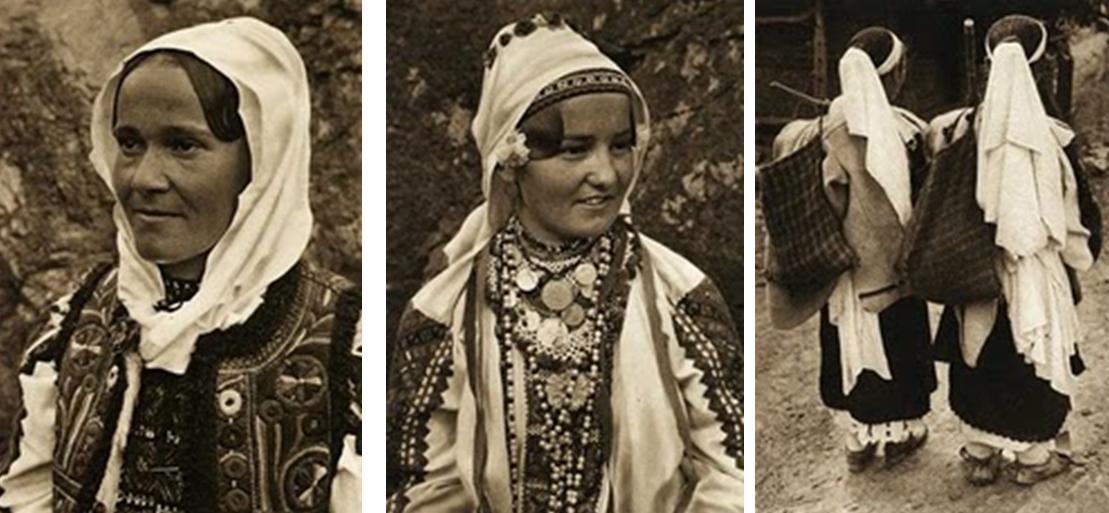
Young wife and girl from Ghelari (Pădureni) and traditional dress from Bunila (Pădureni)
Customs and traditions
The Song of the Fir Tree
"What sets Ținutul Pădurenilor apart in terms of funeral lyric is the Song of the Fir Tree, preserved in Poiana Răchițelii and performed whenever the deceased is young. On the morning of the funeral the young men choose the fir tree in the forest and fell it, after making the sign of the cross, then carry it on their shoulders to the village. At the edge of the forest the symbolic procession is joined by a group of women who, singing the Song of the Fir Tree, lead it to the house of the dead. There the fir tree, its top leaning against the eaves of the house, is decorated by the young girls while the women carry on the dramatic song. (…) After the burial, the fir tree is raised beside the cross and poppy seeds are scattered on the grave. A woman sprinkles water and poppy seeds behind those leaving the cemetery, thus bringing the ceremony to a close." – Grigore Leșe
The Nedei
The nedei are festivals specific to each village. In the pădureni settlements the nedeie is held close to the feast day of the saint who protects the village church, the dates having been set many years ago. As a rule, choice dishes are prepared and guests (relatives and friends) from far away are received. After the church service, the young people hire musicians from the neighbouring villages. Towards evening the musicians arrive at the village hall, awaited eagerly, especially by the young.
Each nedeie has its own particular features. For example, specific to the commune of Cerbăl is carrying the cross out into the fields.
The Measuring of the Milk
The measuring of the milk is a custom hundreds of years old. It takes place before the start of the grazing season and is meant to ensure that the shepherds deliver the correct amount of milk each owner is due. The custom begins the evening before, when the sheep of all the villagers are brought together for the first time on Dealul Strezii (Strezii Hill). They are milked by the most capable people in the village, to make sure that all the sheep have empty udders. This operation is called "roscolul oilor". The next day, the day of the measuring, every pădurean comes to the sheepfold at 12 o'clock and prepares a milking place at the "fruntar". The sheep are brought out of the fold and blessed by the village priest. All the vessels the sheep are milked into, decorated with cheerful flowers, are checked to make sure they contain no water. After that, each person milks his own sheep. The milk obtained is measured and entered into the shepherd's account. This means that from now on the shepherd must obtain from those sheep the same quantity of milk their owner obtained on that day. To keep better track of these quantities of milk, the shepherd carves special marks on his staff. Before the flock departs, the villagers make merry, singing, eating and dancing.
Going Out to the Fields
This custom takes place before the start of the wheat harvest, when the whole village community, led by the priest, goes out into the «țarină » (the farmland around the village) to bless and consecrate the crops. Everything begins with a service at the church, attended by the whole village, even those who have moved away to other parts. Then they set off towards the fields, the crops or the corn, with church banners carried by the young men at the head of the procession. At every crossroads they stop and say prayers for abundance in the home, peace, prosperity and the fruits of the earth. When they reach the fields, the unmarried girls gather stalks of wheat that has only just come into ear and weave them into a beautiful, large wreath. The wreath is placed on a cross at the edge of the field and a special religious service is held for a bountiful harvest.
Traditional cuisine
Zeamă cu brânză (soup with cheese). The broth (soup) is boiled with a few white potatoes. When it is done, kneaded sheep's cheese is added, adjusting it so that it is neither too thick nor too thin.
Sarmale cu păsat (cabbage rolls with păsat) - păsat is a kind of maize meal, but more coarsely ground. Meal, salt, rice and onion were put together and wrapped in cabbage leaves.
The pădureni are also known for their traditional pies. The recipe for pădureni pies has been handed down from generation to generation; even so, it is extremely simple. The dough is made from flour, a little yeast and salt. Once the mixture is smooth, it is kneaded just like bread dough. The consistency, however, should be a little softer. After kneading, the dough is not left to rise. The filling for the pie contains fresh cheese, egg, sour cream and dill. A small piece of dough is taken and rolled out into a round sheet, not too thick, and the filling is placed in its middle. The dough is drawn up over the filling from five corners. Then the pie is fried in hot oil.
Geography
The predominant landforms are hills covered with deciduous and coniferous forests. To the north the land is bounded by the valley of the Mureș River, to the south by Țara Hațegului, and to the west by the Poiana Ruscă Mountains. Ținutul Pădurenilor is a high plateau set between the Țara Hațegului depression to the south and the Mureș Valley to the north, with the uninhabited heights of the Poiana Ruscă Mountains to the west.
The land is made up of the following communes: Bătrâna, Bunila, Cerbăl, Ghelari, Lelese, Lunca Cernii and Vecini.
Spirituality
Multimedia
Bibliography
- http://padureni.wordpress.com/
- http://draganmuntean.blogspot.com/
- http://ghelar.ro/ro/traditii.html
- http://www.tinutulpadurenilor.info/
- http://www.ghelari-primarie.ro/trad.swf
Other ethnographic areas
- Ținutul Secuiesc (Székely Land)
- Țara Zarandului (the Zarand Land)
- Țara Năsăudului (the Năsăud Land)
- Țara Moților (Land of the Moți)
- Țara Bârsei (the Bârsa Land)
- Țara Hațegului
- Țara Făgărașului
0 comments