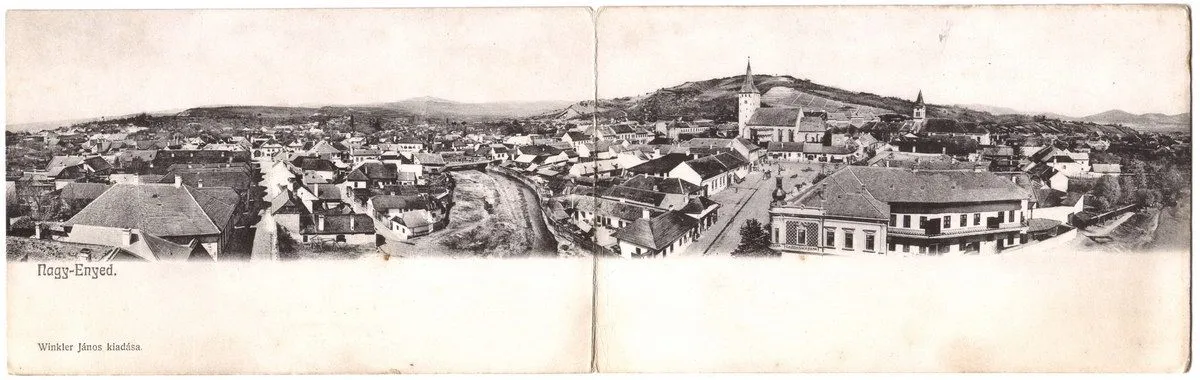
Țara Zarandului (the Zarand Land)
Location
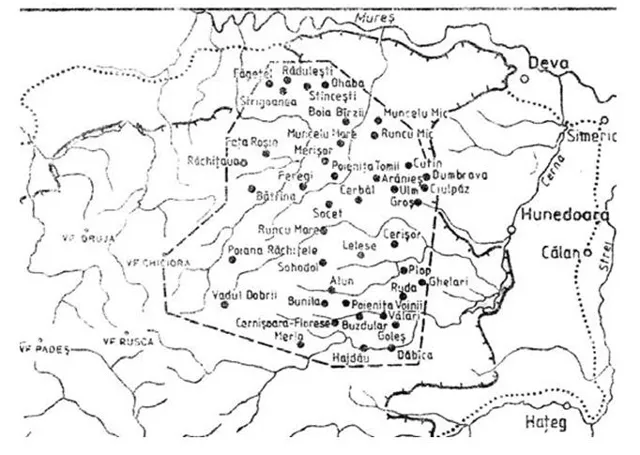
Țara Zarandului (the Zarand Land). A realm almost as large as Maramureș, yet very little known. Stretching across the western slope of the Apuseni Mountains, on both sides of the Crișul Alb (White Criș) river, Țara Zarandului is one of the richest reserves of archaic traditions in Romania. Today it extends over the territory of the counties of Arad, Hunedoara and Alba. In earlier times, however (the 14th–15th centuries), it covered a much larger area: from the "Vulcan rock" on the boundary of Abrud to Bichiș County (Békés, today in Hungary), including the towns of Csaba and Gyula, along the valleys of the Crișul Alb and Crișul Negru, and to the south-west as far as the fortress of Șiria and even into the Banat, at Lugoj. The capital of Țara Zarandului is the village of Țebea, part of the commune of Baia de Criș.
History
The age of Țara Zarandului – of the county, as it was called – "is lost in the mists of history".
It is presumed that these lands were inhabited as early as Roman times, although there is no reliable information to support this hypothesis. What is certain is that the first documentary records of these places date from the 10th century. In 1195, at Baia de Criș, Ladislau Iulius Nicolaus was appointed the first prefect of Zarand County. The oldest documents describe the organisation and administration of the county of Zarand as existing from the 13th century, together with the beginnings of the feudal organisation of Transylvania, but it is known that pre-state organisations already existed in the 11th century. In the Apuseni Mountains there were free Romanian voivodates, within which, in the 13th century, Romanian armies separate from the Hungarian ones appeared. The Transylvanian Romanians took part in the fighting against the Bulgarians. They are also mentioned in the battle of Kressenbrunn in 1260, against Ottokar II, King of Bohemia. In the western part of Transylvania, the Romanian village communities, knezates and voivodates enjoyed autonomy until the 14th–15th centuries.
Information about the Zarand land becomes more substantial in the 16th century, from the period of the Turkish occupation, which lasted, with interruptions, for 150 years, beginning in 1526, when the Turks, after their victory at Mohács, occupied Hungary, and when Zarand County was made up of only four districts: Zarand (named after the commune of the same name), Ineu, Hălmagiu and Brad, with its capital at Ineu (Ienopole).
Being a border land and, for this reason, constantly disputed, in 1741 Zarand County was divided between Hungary and the Principality of Transylvania: the upper part, from Blăjeni-Dupăpiatră to Guravăii, with the districts of Hălmagiu and Brad, keeping the same name of Zarand, which would be retained from then on, was annexed to the Principality of Transylvania, while the territories to the west, with the districts of Zarand, Șiria and Ineu, as far as Gurahonț (inclusive), remained with Hungary. Following these territorial delimitations, the county seat was established at Baia de Criș.
The voivodes of Zarand appear in documents around the middle of the 14th century. The first voivode of Hălmagiu mentioned in documents is "Bybarch Woevoda olahorum de Halmd" (Bibart, voivode of the Vlachs of Hălmagi). A charter drawn up in 1415 states that, between 1404 and 1415, the land was ruled by the Romanian voivode Bolca of Baia de Criș and his sons. For a long period, the history of Baia de Criș merges with that of the Voivodate of Hălmagiu, to which it belonged and whose capital it became in the 16th century.
The Voivodate of Hălmagiu reached its height in 1451. In 1441 it is mentioned as belonging to the fortress of Șiria, which the Serbian despot Gheorghe Brancovici (Đurađ Branković) gave, in 1444, to John Hunyadi (Ioan de Hunedoara), as a reward and in gratitude for his feats of arms. Voivode Moga became "primus inter pares" in 1445, and then "nobilis vir", and acquired the right to mine gold at Baia de Criș. In 1448, at the head of an army from the Crișul Alb Valley, he took part in the battle of Kosovo Polje. He fought alongside his sons Sandrin and Mihail. As a result, both Voivode Moga and his sons were confirmed in their rights by John Hunyadi, through a diploma signed in Timișoara on 10 April 1451. They held 120 villages, from near Gurahonț to Băița, that is, the voivodates of Căpâlna, Hălmagiu and Băița.
It was a flourishing period for Baia de Criș, which in 1519 was declared a Free Royal Town by a decree of King Louis II. Above the powers of the local voivodes stood the authority of the county. Until the battle of Mohács (1526), the county of Zarand belonged to Hungary and covered the territory from the Vulcan rock, near Abrud, along the entire course of the Crișul Alb, bordering the counties of Bihor, Békés, Cenad, Arad and Hunedoara. After the occupation of Hungary by the Turks, following the disaster of Mohács, the county of Zarand was joined to Transylvania under the Peace of Oradea of 1538.
In 1566 the Turks occupied the fortress of Ineu. There followed a period of great insecurity for the villages not occupied by the Turks, as the latter made frequent raids and plundered the Crișul Alb valley until 1595. In 1605 another calamity befell these places: the Pasha of Timișoara laid waste the Crișul Alb valley as far as Baia de Criș.
In 1687 Transylvania came under the rule of the King of Hungary. Following the agreement between him and the voivode of Transylvania, the mountainous part of the county of Zarand remained attached to Transylvania administratively, while paying its taxes to Hungary. In 1784, by order of the Habsburg Emperor Joseph II, the county of Zarand was abolished and incorporated into the county of Hunedoara, but it was re-established six years later, out of the need to keep a closer watch on the serfs and to prevent any attempt at revolt on their part.
In the first half of the 19th century, Baia de Criș had the status of a town, like Hălmagiu, and was the seat of the county, which also included 102 communes. Baia de Criș was one of the places that played an important role in the two revolutionary movements of the 18th and 19th centuries: the uprising led by Horea, Cloșca and Crișan, and the Revolution of 1848, led in Transylvania by Avram Iancu. History also records the participation of the inhabitants of Baia de Criș in the War of Independence, in the two World Wars, and in the Great Union of 1 December 1918.
Tourist attractions
The historic ensemble at Țebea
The traveller who wants to see Țara Zarandului should begin with the place regarded as its capital: Țebea. The historic ensemble here, called the "Pantheon of the Moți", comprises sites of historical importance, firmly rooted in the consciousness of the Moți and in the history of the Romanian people. Avram Iancu, who died on 10 September 1872, is buried in the cemetery at Țebea. Also here, within the "Pantheon of the Moți" ensemble, stands the Orthodox church, itself centuries old.
Monument churches
In the commune of Baia de Criș, right in the commune centre, visitors can see the "Avram Iancu" Memorial House-Museum. It was built on the site of Ioan Stupina's bakery, where Avram Iancu passed away on 10 September 1872. A small museum has been set up here, gathering several objects recalling the "Little King of the Mountains" (Crăişorul munţilor). Besides its rich history, Baia de Criș also stands out for the beauty of two churches on the list of historic monuments. The first of them, the Roman Catholic Church, formerly a monastery, is the most imposing Gothic medieval building in the Crișul Alb valley; it was built at the end of the 14th century, and the tall Gothic windows with harmonious rose tracery bear witness to the beauty of the building. The other church on the list of tourist sights is the Reformed church.
The Crișan Memorial House
The Crișan Memorial House is in the village that bears the hero's name, in the commune of Ribița. The house consists of two buildings made of oak wood. Characteristic of the Zarand area, the house has a rectangular plan, with access from an open porch. The house proper, thatched with straw, has two rooms, used today as a museum. The building was reconstructed from a photograph of an 18th-century peasant house. On display here are ethnographic exhibits from the Ribița area, objects of local history, 18th-century bladed weapons and firearms, and photographic and documentary material relating to the uprising of the Romanian peasants of Transylvania of 1784–1785.
Crișan Monastery (Vaca Monastery)
Crișan Monastery is also known as Vaca Monastery. The Orthodox place of worship stands in the village of Crișan and was built at the end of the 16th century and the beginning of the next through the efforts of the local people. After 1990, Hieromonk Visarion Neag, a former monk at Sihăstria Monastery in Neamț County but born in these parts, took the initiative to re-establish the monastery at Crișan.
The village
The traditional house
The old dwellings are much the same everywhere in Țara Zarandului.
"The traditional houses are built of scalloped timber, skilfully joined at the ends, and the foundations are high. The roof is tall and pointed, made (on the old houses – editor's note) of straw 50–100 cm thick. The dwellings have two rooms, with cellars below and façades with columns, posts and arches," notes Dumitru Rus in his book Județul Hunedoara, ghid turistic (Hunedoara County: A Tourist Guide).
Traditional occupations
The people of these parts call themselves "Moți of the Criș" ("We are Criș Moți! We're something other than the Moți proper, but we too are from Iancu's army..."), people renowned for their industriousness in a land that is far from rich. The traditional trades of the area are:
- Mining- one of the inhabitants' basic occupations. They worked either in the gold mines of Brad or Caraci, or in the coal mines of Țebea.
- Sheepskin coat making-It took firm root as early as the 15th century in the Orăștie area, after which it spread to other regions, especially the Crișul Alb Valley and the Mureș Valley. Baia de Criș was for a long time an important centre of sheepskin coat makers.
- Reed-making -This is the craft of making the reeds (combs) for weaving looms, which for centuries was a speciality of the village of Rișculița. The craft was brought to the village long ago, apparently from Moldavia, by a certain Gruiță. Later it was also taken up by the inhabitants of Baldovin.
- Lime production - Limestone is found in abundance, especially at Rișculița. Its quarrying began at the end of the 18th century. The stone was extracted from two galleries, next to which stood primitive kilns for burning the limestone. The craft is still practised sporadically today.
- Agriculture and animal husbandry
Folk costume
The folk costume is specific to the Criș valleys. It is fairly simple, but is now worn very rarely, by the elderly on feast days or on stage during folk performances. Characteristic are the unsophisticated embroideries with flowers, small crosses and black bands. Women wear a black leather waistcoat covered in dense embroidery, and men wear the "sarică" (a coat of sheepskins).
"In summer the men wear hats with wider brims turned up, decorated with gilded thread or with cord wound 3 or 4 times around the crown and then left hanging in tassels at the back, or straw hats. In winter some wear black sheepskin caps. Their shirts are made of linen, cotton or fine muslin, with the collar standing up or turned down, decorated with red or black cotton thread, or with plain thread. The shirts have narrow sleeves, with cuffs sewn in bands, borders and little 'eyes' of cotton thread or plain thread. Over the shirts they gird themselves with wide leather belts (șerpare). Over the belt they wear a 'laibăr', loose and reaching to the hips, woven of hemp or cotton with 'little eyes'. The 'cioareci' (trousers tight on the leg – editor's note) are of wool and simply sewn. (...)
The girls wear on their heads a kerchief (năframă, chischineu), white or multicoloured and tied at the back. Married women wear a head covering of muslin or cotton. They have a blouse (ie) reaching to the hips and separate from the underskirt. On either side of the neck the ie has a 'gurăluș', embroidered with black or red cotton thread in 'bands' or 'borders'. The neck opening of the shirt is embroidered with cotton thread or silk. They also wear a 'laibăr' of linen, twisted cotton (misir) or broadcloth. They gird their waists with woollen sashes or belts. At the back (over the underskirt) they wear an 'opreg', 'catrință' or 'zadie' of black or variously coloured wool, and in front an apron. As winter garments they have the 'tundră', a woollen 'laibăr' or a 'subă', like the men," says Atanasie Bran in Monografia județului Hunedoara (Monograph of Hunedoara County), published in 2001.
Customs and traditions
Most elements of folk culture are almost identical to those of the Moți of the Apuseni Mountains, with whom the inhabitants of the Crișul Alb Valley have been in constant contact over the centuries.
• Folk dances
The traditional folk dance is similar to that of the Apuseni Mountains, proving once again that it is not for nothing that Țara Zarandului is also called the "Land of the Criș Moți". The most common dance is the "țarina" or "abrudeanca", but the învârtita, jianca and sdruhaita are also danced. The călușer, brought from other parts of Transylvania, has also taken root.
• The Nedei
These are country fairs, usually associated with the patron saints' days of the churches in the villages concerned. The nedeie is one of the greatest festivals of the village. It is the occasion when those who have left for other parts return home for a few days. Families come together again around the festive table, and towards evening the dancing begins, like the round dances of old.
• "Ciorolița"
This is a unique custom, preserved in a single hamlet of the village of Țebea. "Ciorolița" is a collective character that haunts the village lanes on the night before Epiphany (5 to 6 January). Masked young men walk a route of almost ten kilometres, accompanied by nearly the whole village. The procession begins, however, only after the priest has carried the Epiphany blessing to the very last house. The strange procession stops at only two houses: the priest's and that of a host who "treats" the masks (gives them food and drink). They personify every possible wicked person in humankind: the drunkard, the thief, the murderer, the harlot and so on, and their arsenal includes any object that can make noise. On that night the whole village seems to be on fire. Bonfires are lit at every crossroads, and around them the masks and their companions dance, make noise and let out terrifying cries, to drive the evil spirits away from the village. Every year, however, the route ends in the cemetery at Țebea, at the grave of Avram Iancu. The masks perform their dance, after which all those accompanying them bare their heads and pray.
The origins of the custom are not known. Although its date is linked to a religious feast, the whole proceedings suggest a secular custom, even one with barbaric touches. Some say it was brought from Bukovina, from around Rădăuți, after the Great Union of 1 December 1918, by young men who had served as gendarmes in that area under Austrian rule.
• The Maidens' Fair on Mount Găina
This is the greatest annual festival of the inhabitants of the Apuseni Mountains and their foothills. Tens of thousands of people gather, the day before, on the peak where the boundaries of four counties meet (Hunedoara, Arad, Alba and Bihor), spend the night around the fires and wait for the signal given at dawn by the women playing the tulnic (alphorn).
The Maidens' Fair on Mount Găina takes place every year on the Sunday closest to the feast of Saint Elijah (20 July). This ethno-cultural event was first mentioned in documents in 1816. The fair is held in a beautiful glade on Găina Peak, at an altitude of 1,467 m. In olden times the inhabitants of the various valleys of the Apuseni used to gather there to exchange goods. The fair made it possible for young people from distant areas to meet and marry, thus avoiding marriages between relatives.
Multimedia
|
Țara Zarandului |
Folklore of Țara Zarandului |
Folklore of Țara Zarandului |
Bibliography
- http://www.baia-de-cris.ro/ro/potential/traditii.htm
- Baia de Criș, „capitala” Zarandului (Baia de Criș, the "capital" of Zarand), unsigned, 13-11-2008, no. 1149, Servus Hunedoara
- România necunoscută, Țara Zarandului (Unknown Romania: Țara Zarandului), article published in Formula AS, by Bogdan Lupescu.
- Nestor Lupei, Romulus Neag, Circo Stelian, Gavrilă Pașcu, "Monografia Colegiului Național "Avram Iancu" Brad", revised and expanded edition 1869-2009, Brad 2009.
- Sabin and Maria Cioica, Legendele Munților Apuseni (Legends of the Apuseni Mountains), Editura UNIREA, Alba Iulia
- Atanasie Bran, Monografia județului Hunedoara, Editura MATINAL, Petroșani, 2001.
- Dumitru Rus – Județul Hunedoara, ghid turistic, Editura Sigma Plus, 1998
Other ethnographic regions
- Ținutul Secuiesc (Székely Land)
- Ținutul Pădurenilor (the Land of the Forest People)
- Țara Năsăudului (the Năsăud Land)
- Țara Moților (Land of the Moți)
- Țara Bârsei (the Bârsa Land)
- Țara Hațegului
- Țara Făgărașului
0 comments