Țara Moților (Land of the Moți)
Location
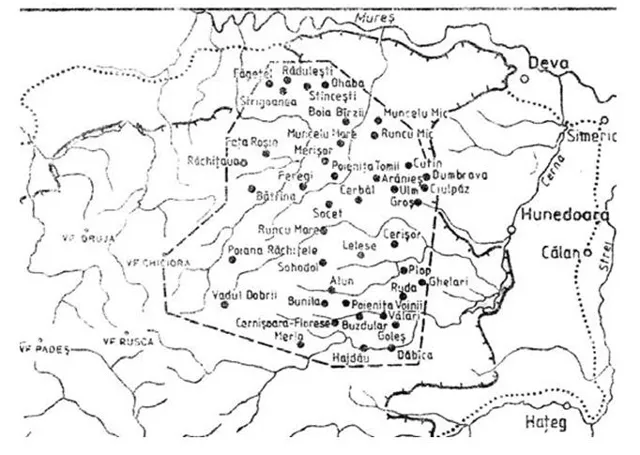
Țara Moților (the Land of the Moți) - or Țara de Piatră (the Land of Stone), as it is also known - lies in the Apuseni Mountains. Situated in the upper basins of the Arieș and Crișul Alb rivers, Țara Moților includes geographical areas of five counties: Arad, Alba, Bihor, Timiș and Cluj.
"the notion of Moț includes all the inhabitants of the villages starting from the edge of Cluj, but above all from Gilău, southwards as far as Baia de Criș and Brad, as well as those who populate the villages from Presaca, near Zlatna, westwards, Abrud, Câmpeni and beyond Vidra de Sus and towards Hălmagiu and the Bihor Mountains, that is, as far as Beiuș."
History
There are several theories about the origins of the Moți - or Țopi, as they were called in the past. Of these, the most widely accepted holds that the Moți are the direct descendants of the Dacians and of the Roman colonists brought by Emperor Trajan after the conquest of Dacia in the year 105 to work in the gold mines of the area. In support of this, in his book Moții, calvarul unui popor eroic dar neîndreptățit. Studiu istoric–politic (The Moți, the Calvary of a Heroic but Wronged People. A Historical-Political Study), Ion Rusu Abrudeanu maintained that "The name Moți comes from the ancient chică, the tuft of hair (moț) worn by the men, which was a Dacian custom, still in use in the Land of the Moți until the second half of the last century. In my own childhood, 50 years ago, I still saw many old Moți with their hair gathered in a tuft, usually on the right side of the head, near the ear."
The name Țopi comes from the territory they inhabited - between the Mureș and the Bihor Mountains - which was called Terra Tzopus. Indeed, the name Țopi is also found in the description of Transylvania by the Byzantine emperor Constantine Porphyrogenitus (912-959), who in the 10th century called them Tzopon.
At the head of these territories was a Romanian voivode, whose seat was at Abrud, where an old church from those times still stands today. Abrud is a name of purely Dacian origin, from the word Abruttus, which in turn derives from the Dacian word abrudiom, meaning gold. Likewise, both the old name of Zlatna (Ampelum) and that of Roșia Montană (Alburnus Maior) are also words of Dacian origin.
Tourist attractions
Scărișoara Cave
It lies within the commune of Gârda de Sus, in Alba County, is part of the Ghețar - Ocoale - Dobrești karst system, and holds the largest underground glacier in Romania.
Peștera Urșilor (the Bears' Cave)
It is one of the main tourist sights of the Apuseni Mountains, located in Bihor County, right next to the village of Chișcău, Pietroasa commune, at an altitude of 482 m. Inside it, an impressive quantity of traces and fossils of the cave bear - Ursus spelaeus - which became extinct 15,000 years ago, has been found.
"Poarta lui Ionele" Cave (Ionele's Gate)
It is located in the commune of Gârda de Sus, Alba County, in the Bihor Mountains.
"Focul Viu" Cave (the Living Fire)
It is one of the caves of the Bihor Mountains. It lies in the Galbena Valley, near the peaks of Piatra Galbenii and Cuculeul de Fier, at an altitude of 1,165 metres, and holds an impressive glacier at its centre. The glacier is the third largest, after those of Scărișoara and Borțig.
Dealul cu Melci (the Snail Hill)
Cheile Turzii (Turda Gorge)
Cheile Vălișoarei (Vălișoara Gorge)
Cheile Gălzii (Galda Gorge)
Cheile Ampoiței (Ampoița Gorge)
Cheile Ordâncușii (Ordâncușa Gorge)
Avram Iancu
Arieșeni
Vidra
The Maidens' Fair on Mount Găina
Traditional cuisine
Geography
When we think of Țara Moților we naturally think of the Apuseni Mountains, the home of the Moți. Bounded to the north by the Someș Plateau, to the east by the Transylvanian Plateau, to the south by the Mureș corridor and to the west by the Western Plain, they are made up of crystalline schists, granites, limestones and volcanic tuffs. They are not very high, the highest peak - Cucurbăta Mare (Bihor Mountains) - reaching barely 1,849 m, but they contain rich deposits of gold and silver ores, bauxite and coal. They are covered with deciduous and coniferous forests, and are at the same time an important tourist area, with numerous chalets, caves, gorges, defiles and spa and climatic resorts.
The village
The people
The local people are mainly engaged in woodworking and mining. They also practise mountain farming (on slopes and terraces), shepherding and forestry.
The village
The villages of Țara Moților are generally scattered settlements, the Apuseni Mountains being dotted with houses at relatively high altitudes. In the villages of the area one finds a great wealth of ancient elements specific to the civilization and culture of the Romanian people, such as the polygonal barn, the colnă (granary) and other farm buildings characteristic of Țara Moților, folk architecture, traditional farmsteads and houses, as well as a valuable heritage of ethnographic and folk art objects.
The traditional house
In the region of the Apuseni Mountains, in olden times (up to the 18th century), houses were built almost entirely of thick round logs laid in horizontal rings. The houses usually had an enclosed, fortified courtyard and a polygonal barn. Their special charm came from the 1/3 ratio between the height of the walls and that of the roof. Traditional houses were most often raised on high stone foundations, with a raised porch bordered by posts joined by wooden arches.
Customs and traditions
The fairs of Țara Moților
The Romanians of Țara Moților had the custom of holding annual fairs on the mountain tops, such as: the Maidens' Fair on Mount Găina, the Kissing Fair in the commune of Hălmagiu, and the fairs at Călineasa, Biharia or Lespezi. The Maidens' Fair takes place on the first Sunday after the feast of Saint Peter, the Kissing Fair was held on the feast of Saint Theodore, and the Călineasa Fair on Saint Peter's Day. Sadly, the fairs on the Biharia and Lespezi mountains have been abandoned.
Easter customs
In Țara Moților, on Easter night, the church's toacă (wooden semantron) is carried to the cemetery, where it must be guarded by the young men of the village. If they fail to keep it safe and it is stolen, the guards who failed must offer a rich feast the next day. If those who tried to steal the toacă do not succeed, they will be the hosts of the feast.
Spirituality
Multimedia
|
The Free Dacians of Țara Moților |
Țara Moților |
Dumitru Fărcașu - Suite from Țara Moților |
Bibliography
http://www.taramotilor.ro/cap15.html
Ion Rusu Abrudeanu, Moții, calvarul unui popor eroic dar neîndreptățit. Studiu istoric – politic, Cartea Românească, București, 1928.
Other ethnographic regions
- Ținutul Secuiesc (Székely Land)
- Ținutul Pădurenilor (the Land of the Forest People)
- Țara Zarandului (the Zarand Land)
- Țara Năsăudului (the Năsăud Land)
- Țara Bârsei (the Bârsa Land)
- Țara Hațegului
- Țara Făgărașului
0 comments