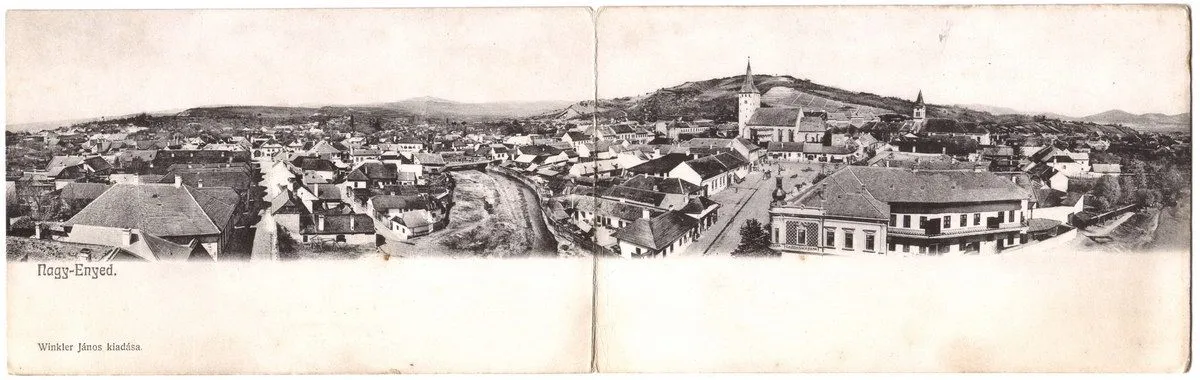
The Kissing Fair of Hălmagiu
Few people know that, besides the Maidens' Fair on Mount Găina, the Moți also celebrated the Kissing Fair. This rather unusual fair took place in Hălmagiu – a Romanian commune in the valley of the Crișul Alb, at the foot of Mount Găina – and was held every year on Saint Theodore's Day (Sân Toader). The Kissing Fair is also called the Brides' Fair, because on that day all the young wives from the neighbouring communes come to Hălmagiu, where they kiss their relatives, acquaintances and even strangers, if they are told that these are leading and honourable men, and when the young wife is sure she will not be refused.
"If the weather is fine on Saint Theodore's Day, the fair at Hălmagiu teems with young wives who, having been maidens, married during the season before the fast. To this fair go the new brides from the neighbouring communes, Ociu, Ocișor, Poienari, Tohești, Bănești, Hălmăgel etc., and they are joined by the new brides of Hălmagiu. It should be noted that only the wives who were maidens go to the fair, and not widows who have remarried. The wives who have mothers-in-law go with them, and those who have none go together in twos and threes, very finely dressed and with their bridal wreaths on their heads. Often their fathers-in-law, or even their husbands, take them by ox-cart or wagon as far as Hălmagiu, where they never walk about the fair alone. When the wives arrive in Hălmagiu, the fair takes on an interesting appearance. Good cheer, laughter and jest are the hallmark of this fair. Early in the morning the wives begin to walk about the fair accompanied by their mothers-in-law or in twos and threes, and when they meet kinsfolk and acquaintances, or see them from afar, they run to them and kiss them; and these honour them with money, from kreuzers up to florins. With strangers they are very reserved, for to be left unkissed is the greatest insult. Only when the wife is positively informed that she will not be refused does she kiss a stranger too. The kissing takes place in the streets, in the taverns and in the houses of acquaintances. After the kiss, having received the gift, the wife gives thanks by raising a toast from her jug. Not to drink means to insult the wife and her family. To be kissed by a young wife in Hălmagiu on Saint Theodore's Day means to be a leading and honourable man." (Teofil Frâncu and George Candrea, Românii din Munții Apuseni, Bucharest: Tipografia Modernă, 1888, pp. 54-55).
Ion Rusu Abrudeanu also wrote about this festival in his book Moții, calvarul unui popor eroic dar nedreptățit. Studiu istoric – politic (The Moți: The Calvary of a Heroic but Wronged People. A Historical and Political Study), as follows: "In the morning, the young wives from 50–60 villages, very finely dressed and with their bridal wreaths on their heads, in groups of two or three, accompanied by their mothers-in-law, begin to walk about the fair, and as soon as they meet relatives and acquaintances they run to them and kiss them, and these honour them with money, each according to his means and as his heart moves him. With strangers they are very reserved, for to be left unkissed is the greatest insult. When, however, the wives are informed that they will not be refused, then they kiss the stranger too. After the kiss, having received the gift, the wife gives thanks by raising a toast from a jug of wine. Not to drink means to insult the wife and her family. Immoral things and quarrels never arise. Morality and order are kept by the public itself, which watches over good manners. Nothing definite is known about the origin of this fair. People found this custom already in place and keep it from generation to generation. Tradition says that the Kissing Fair of Hălmagiu dates from the time of the Turkish invasions, when the Turks, pushing as far as the valley of the Crișul Alb, are said to have carried off a great many women of the Criș, some of whom, escaping from captivity and returning home, kissed all the acquaintances they met, and these honoured them for their courage and their love for their ancestral language and hearth."
Bibliography
- Teofil Frâncu and George Candrea, Românii din Munții Apuseni (moții), Bucharest: Tipografia Modernă, 1888, pp. 54-55
- Ion Rusu Abrudeanu, Moții, calvarul unui popor eroic dar nedreptățit. Studiu istoric – politic, Cartea Românească, Bucharest, 1928.
Other unusual things from Transylvania
- Bolii Cave
- Freemasonry in Transylvania
- The Dinosaurs of Hațeg Island
- The Snail Hill (Dealul cu Melci)
- Underground Cluj
- The Cave Paintings of Coliboaia Cave
- The Red Caps (Șepcile Roșii)
- Armindeni
- The Cave Paintings of Cuciulat
- The Secret of Vlad Țepeș: The Love from Corona
- Claudia Rhédey de Kis-Rhéde
- What Became of Vidra after Răzvan's Death
- Witch Trials in Transylvania
0 comments